
Technical solutions
Solutions for water treatment, desalination and wastewater treatment
We tie every solution to an actual need of the client: the water source, the water quality required, and the site and operating conditions.
Overview
Seawater desalination
Seawater reverse osmosis (SWRO) with pre-treatment, post-treatment and energy recovery.
DetailsBrackish water
Brackish water reverse osmosis (BWRO) at lower pressures and higher recovery than seawater.
DetailsDrinking water
Drinking water plants: coagulation, flocculation, sedimentation, sand filtration and disinfection.
DetailsIndustrial water
Demineralization and water polishing for utilities at industrial and petrochemical facilities.
DetailsWastewater
Biological wastewater treatment, including MBBR, with sludge treatment and disinfection.
DetailsCompact units
Standard water and wastewater units that install quickly and expand by adding identical modules.
DetailsSupporting equipment and systems
What determines operating cost and reliability
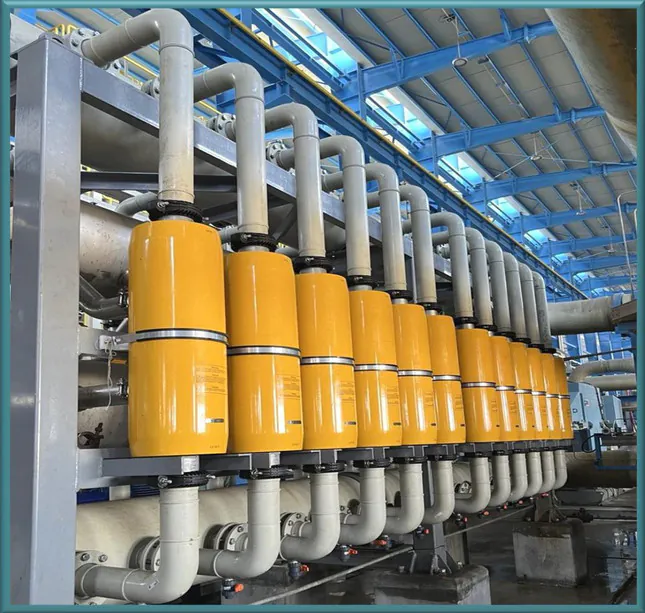
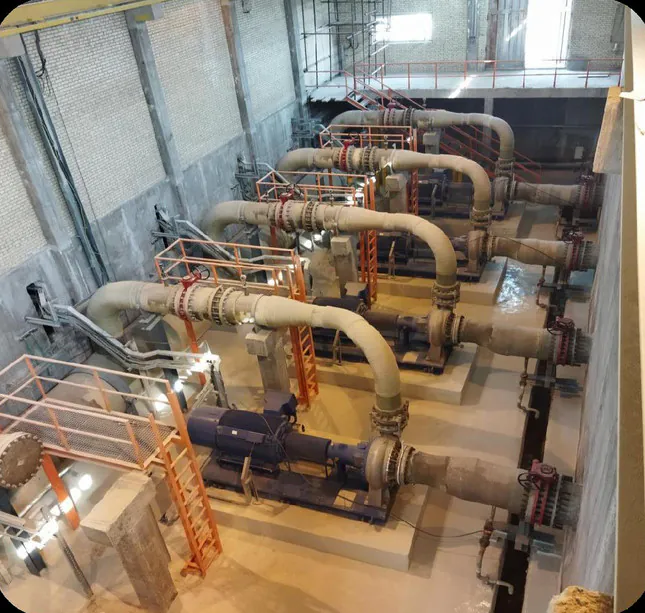
Supporting equipment determines a plant’s operating cost and reliability. The main items are shown here with examples from the desalination and drinking water references.
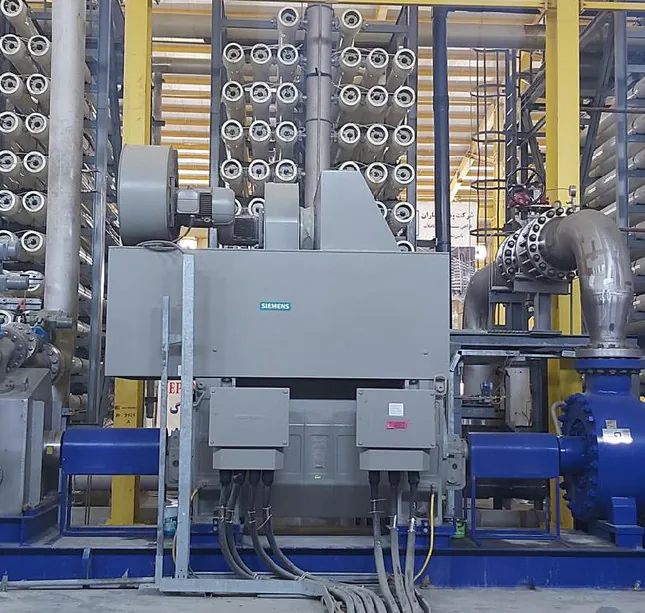
High-pressure pumps
First-pass pump in the 100,000 line reference: 1,254 m³/h at 69 bar, with a Pelton turbine that cuts motor power by about 40%.
Pressure exchangers
In the 200,000 line reference: 216 PX-Q300 pressure exchangers, 24 per train, recovering energy from the brine.
Booster pumps
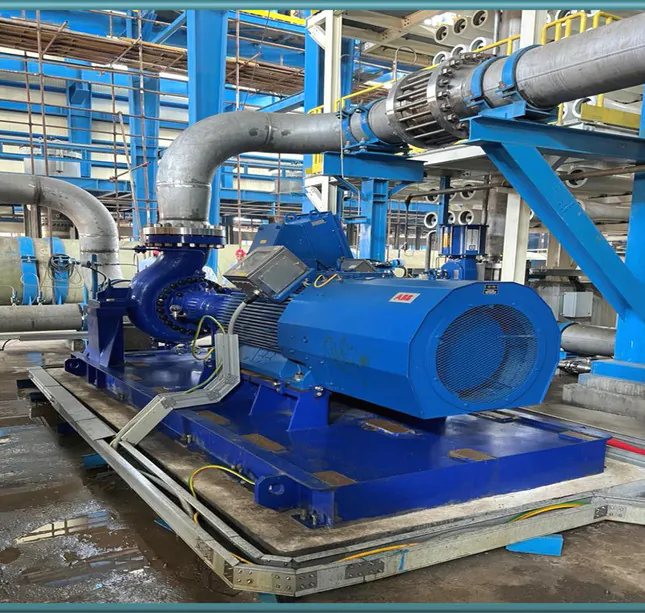
Raise the pressure of the feed water leaving the pressure exchangers; 9 pumps of 1,575 m³/h in the 200,000 line reference.
Feed pumps
Supply filtered water to the reverse osmosis units; 6 pumps (5+1) with a normal capacity of 2,515 m³/h in the 100,000 line reference.
Air blowers
For filter backwashing and for aerating biological treatment basins; a 3,640 m³/h blower at 500 mbar in the 100,000 line reference.
Chemical dosing and disinfection
Dosing of coagulants and antiscalant, pH adjustment, and electrochlorination units as at the Al-Abbas water treatment plant.
Other systems in the references: membrane flushing and clean-in-place (CIP) systems, cartridge filters, lime and carbon dioxide systems for post-treatment, UV units, and sludge thickening and dewatering equipment.
Quality, safety and environment
Considerations built into the design itself
Quality and safety are built into the design itself before they are written into procedures. These considerations appear in the data of the technical references.
Quality
Water quality defined in advance
Each plant has a water-quality target; for example, dissolved solids below 500 mg/L for the product water in the 100,000 line reference.
Continuous measurement
Flow, pressure, conductivity, pH, chlorine and turbidity are measured on the feed line.
Standby for critical equipment
Duty and standby pumps, blowers and filters, such as (4+1) and (20+2).
Safety
Chemicals
Acids, alkalis and coagulants are stored and injected through closed dosing systems.
Safe disinfection
Hypochlorite is generated on site by electrochlorination, which avoids handling chlorine gas.
High pressures
Vessels and piping rated for the operating pressure of the reverse osmosis units.
Environment
Effluent quality
Design values for BOD, COD and suspended solids in the treated water.
Sludge and odors
Sludge thickening and dewatering, and odor removal by biofilter as in the Al-Hartha reference.
Energy and water
Brine energy is recovered, and the brine is reused for filter backwashing in the 200,000 line reference.
Quality, safety and environmental requirements are applied on every project in line with the contract conditions and the Iraqi legislation in force.
Request a study or proposal
Start with your project data.
Send us your project data. Our technical team reviews it and comes back with the right next step: a preliminary study, or a technical and commercial proposal.
Data that helps us prepare the proposal
- The water source and a recent analysis of it.
- The required capacity and its unit: m³/day or m³/h.
- The required product-water or effluent quality.
- The project site, available area and power source.
- The scope required: study, supply, or full execution.
- The expected project schedule.