
Technical solution · SWRO
Seawater desalination by reverse osmosis
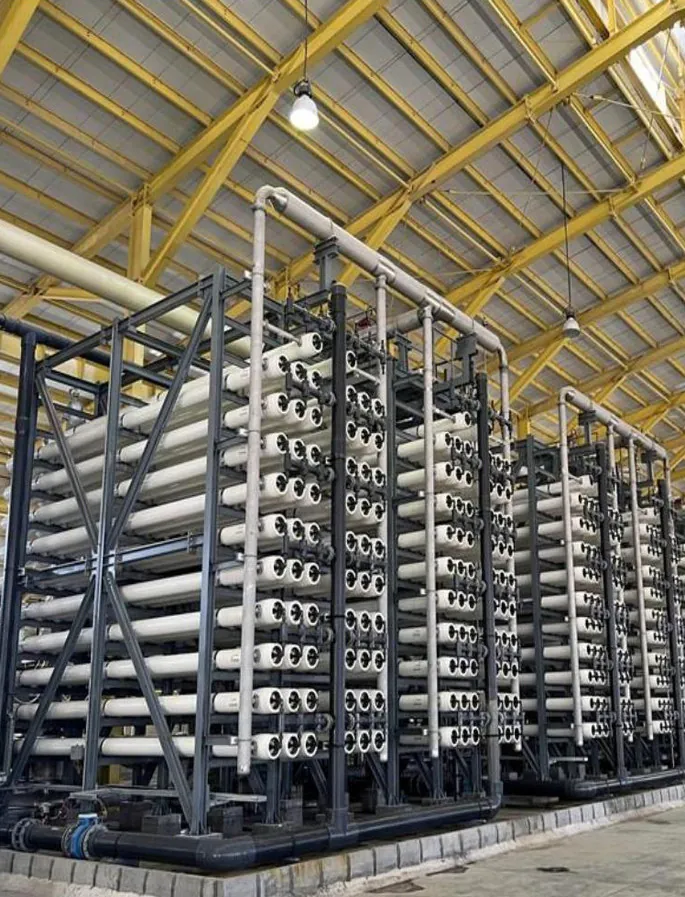
Reverse osmosis (RO) separates salts from seawater by forcing it at high pressure through semi-permeable membranes. Applied to seawater, the process is known as SWRO.
Overview
Application
Drinking water for coastal cities; service, cooling and fire-fighting water for industrial and petrochemical facilities; and feed water for demineralization units.
Key technical elements
- Pre-treatment: coagulation and flocculation followed by dual-media filtration, or dissolved air flotation (DAF) ahead of filtration.
- Membrane protection: cartridge filters, plus dosing to remove residual chlorine and prevent scaling.
- High pressure and energy recovery: high-pressure pumps with Pelton turbines or pressure exchangers.
- Membranes: spiral-wound composite polyamide elements in 8-inch pressure vessels.
- Post-treatment: pH adjustment, or remineralization with lime and carbon dioxide.
Desalination chain
From the sea intake to the product-water tank
- Seawater intake
- Coagulation and flocculation
- Filtration
- Cartridge filters
- High pressure and energy recovery
- Reverse osmosis membranes
- Post-treatment
- Storage and pumping
General illustration; the units and their order vary with seawater quality and the requirements of each project.
Technology comparison
Multi-stage flash and reverse osmosis
| Item | Multi-stage flash (MSF) | Reverse osmosis |
|---|---|---|
| Energy consumption | about 13 kWh/m³ | 2.5–5 kWh/m³ |
| Recovery ratio | 10–20% | 30–50% |
| Room for development | Low | High |
| Operating sensitivity | Highly robust | Requires feed-water monitoring |
Related references
100,000 m³/day desalination line
For petrochemical utilities, with Pelton turbines.
View reference Technical reference200,000 m³/day desalination line
For drinking water, with pressure exchangers.
View reference Technical referenceContainerized drinking-water unit, 600 m³/day
Basra Police Training Centre.
Basra project listOther solutions
Other areas of water solutions
Brackish water
Brackish water reverse osmosis (BWRO) at lower pressures and higher recovery than seawater.
DetailsDrinking water
Drinking water plants: coagulation, flocculation, sedimentation, sand filtration and disinfection.
DetailsIndustrial water
Demineralization and water polishing for utilities at industrial and petrochemical facilities.
DetailsWastewater
Biological wastewater treatment, including MBBR, with sludge treatment and disinfection.
DetailsCompact units
Standard water and wastewater units that install quickly and expand by adding identical modules.
DetailsRequest a study or proposal
Start with your project data.
Send us your project data. Our technical team reviews it and comes back with the right next step: a preliminary study, or a technical and commercial proposal.
Data that helps us prepare the proposal
- The water source and a recent analysis of it.
- The required capacity and its unit: m³/day or m³/h.
- The required product-water or effluent quality.
- The project site, available area and power source.
- The scope required: study, supply, or full execution.
- The expected project schedule.