
Technical solution · MBBR
Biological wastewater treatment
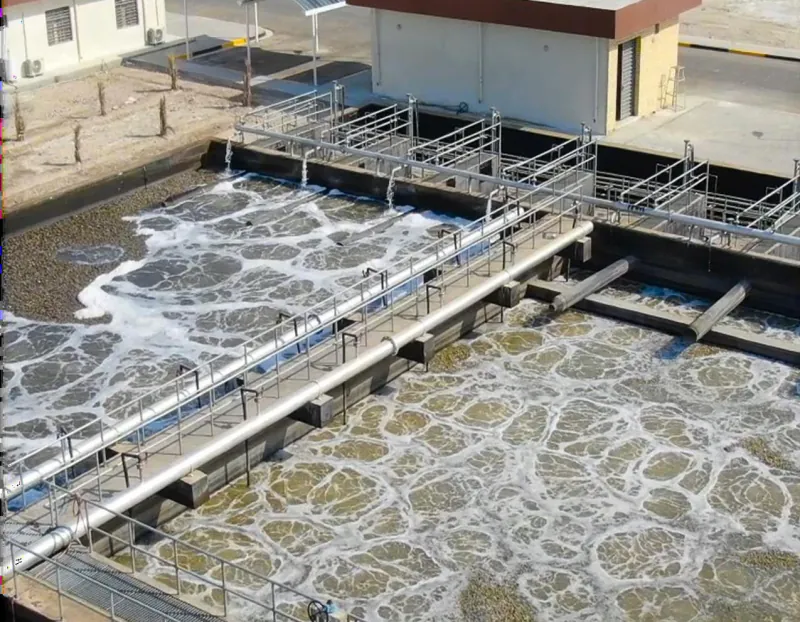
Biological treatment of wastewater (sewage) relies on micro-organisms that consume organic pollutants. In the moving bed biofilm reactor (MBBR) process, these organisms grow on plastic carriers that move inside an aerated basin.
Treatment chain
A biological treatment plant
- ScreeningMechanical and manual
- Grit and oil removal
- EqualizationFlow regulation
- Biological treatmentMBBR and bioreactor
- Sedimentation or polishing
- DisinfectionUV or chlorine
- Sludge treatmentStorage and dewatering
General illustration of a biological treatment plant; the order of units differs between projects.
Overview
What does MBBR mean?
Moving Bed Biofilm Reactor: a bioreactor in which micro-organisms grow as a film on moving carriers.
Application
Wastewater plants for cities and districts, residential compounds, airports and camps, with design of the collection networks where needed.
Key technical elements
- Preliminary treatment: screening, grit and oil removal, an equalization basin and lift pumps.
- MBBR basins with bioreactors and air blowers.
- Sedimentation or a polishing basin, followed by disinfection.
- Sludge treatment: thickening, storage and dewatering.
- Odor removal by biofilter where needed.
Practical benefit
Smaller basins than conventional treatment for the same organic load, operation that tolerates fluctuating flow and load, and room to expand by adding carriers or basins.
References in Basra
Three wastewater treatment plants
Al-Midaina plant
MBBR with bioreactors and UV disinfection. Nominal capacity 10,000 m³/day.
View reference Technical referenceAl-Qurna plant
MBBR with bioreactor. Nominal capacity 35,000 m³/day.
View reference Technical referenceAl-Hartha plant
Sedimentation and aeration with odor removal. Capacity 16,000 m³/day.
View referenceOther solutions
Other areas of water solutions
Seawater desalination
Seawater reverse osmosis (SWRO) with pre-treatment, post-treatment and energy recovery.
DetailsBrackish water
Brackish water reverse osmosis (BWRO) at lower pressures and higher recovery than seawater.
DetailsDrinking water
Drinking water plants: coagulation, flocculation, sedimentation, sand filtration and disinfection.
DetailsIndustrial water
Demineralization and water polishing for utilities at industrial and petrochemical facilities.
DetailsCompact units
Standard water and wastewater units that install quickly and expand by adding identical modules.
DetailsRequest a study or proposal
Start with your project data.
Send us your project data. Our technical team reviews it and comes back with the right next step: a preliminary study, or a technical and commercial proposal.
Data that helps us prepare the proposal
- The water source and a recent analysis of it.
- The required capacity and its unit: m³/day or m³/h.
- The required product-water or effluent quality.
- The project site, available area and power source.
- The scope required: study, supply, or full execution.
- The expected project schedule.