
Technical solution
Industrial water, demineralization and condensate polishing
Boilers and industrial processes need water that is almost free of salts. It is produced by demineralization units downstream of desalination, or by polishing water and returned condensate.
Overview
Application
Utilities at oil, petrochemical and power facilities: boiler feed water, process water, cooling water, and service and fire-fighting water.
Key technical elements
- Primary desalination by two-pass reverse osmosis to reduce salts.
- Demineralization units to polish the product water.
- Epoxy-coated product-water tanks.
- pH adjustment by caustic soda dosing.
- Duty and standby units to keep supply continuous.
Evidence from the references
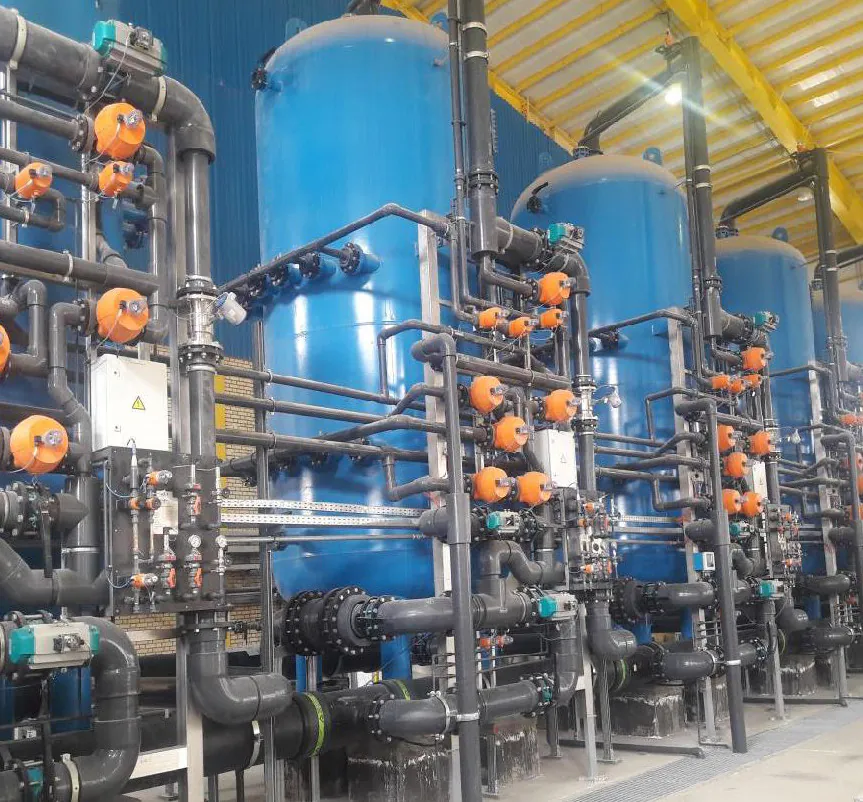
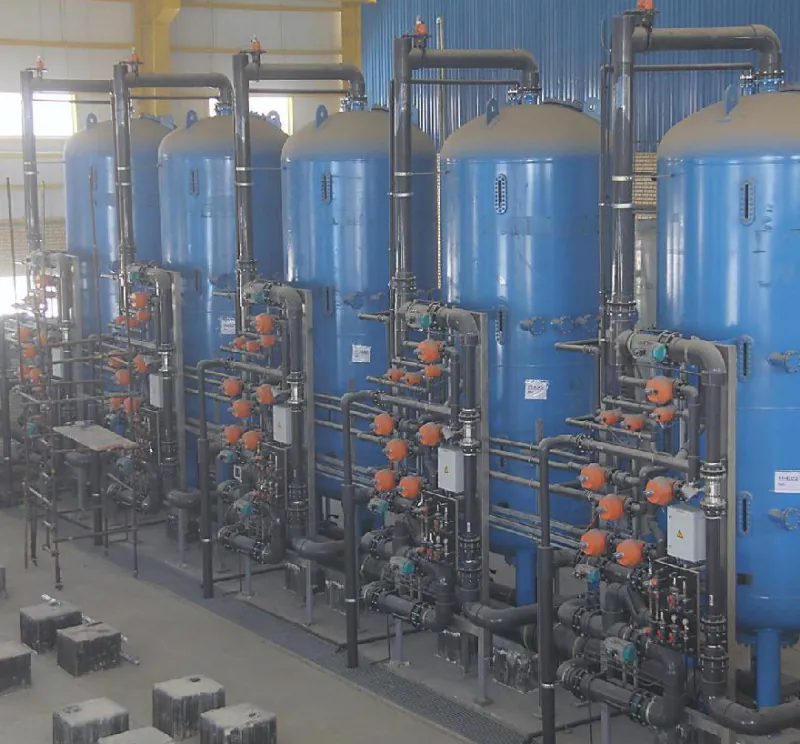
The demineralization unit
- Total capacity
- 780 m³/h
- Number of units
- 5 (4 duty + 1 standby)
- Unit capacity
- 195 m³/h
- Inlet dissolved solids
- 20 ppm
- Outlet dissolved solids
- less than 0.05 ppm
Data from the 100,000 m³/day desalination line reference.
Water uses in the reference
Cooling water, service and drinking water, and fire-fighting water, in addition to demineralized water.
Other solutions
Other areas of water solutions
Seawater desalination
Seawater reverse osmosis (SWRO) with pre-treatment, post-treatment and energy recovery.
DetailsBrackish water
Brackish water reverse osmosis (BWRO) at lower pressures and higher recovery than seawater.
DetailsDrinking water
Drinking water plants: coagulation, flocculation, sedimentation, sand filtration and disinfection.
DetailsWastewater
Biological wastewater treatment, including MBBR, with sludge treatment and disinfection.
DetailsCompact units
Standard water and wastewater units that install quickly and expand by adding identical modules.
DetailsRequest a study or proposal
Start with your project data.
Send us your project data. Our technical team reviews it and comes back with the right next step: a preliminary study, or a technical and commercial proposal.
Data that helps us prepare the proposal
- The water source and a recent analysis of it.
- The required capacity and its unit: m³/day or m³/h.
- The required product-water or effluent quality.
- The project site, available area and power source.
- The scope required: study, supply, or full execution.
- The expected project schedule.