
Technical solution · BWRO
Brackish water treatment and desalination
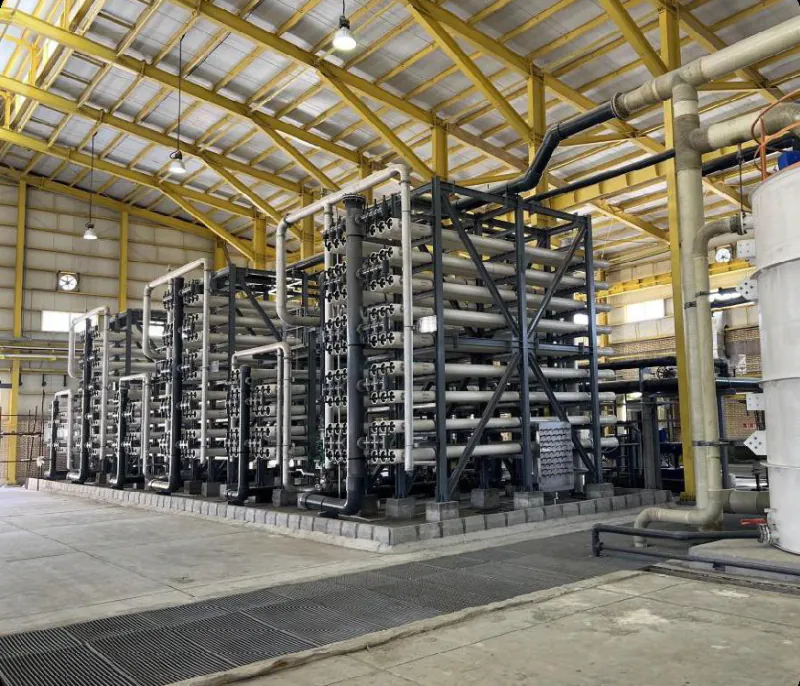
Brackish water is less saline than seawater, so it is desalinated by reverse osmosis at lower pressures and higher recovery ratios. This application is known as BWRO.
Overview
Application
River and well water affected by salinity, industrial feed water, and polishing of the permeate from a first desalination pass.
Key technical elements
- Pre-treatment matched to the turbidity of the source: filtration and disinfection.
- Antiscalant dosing and pH adjustment.
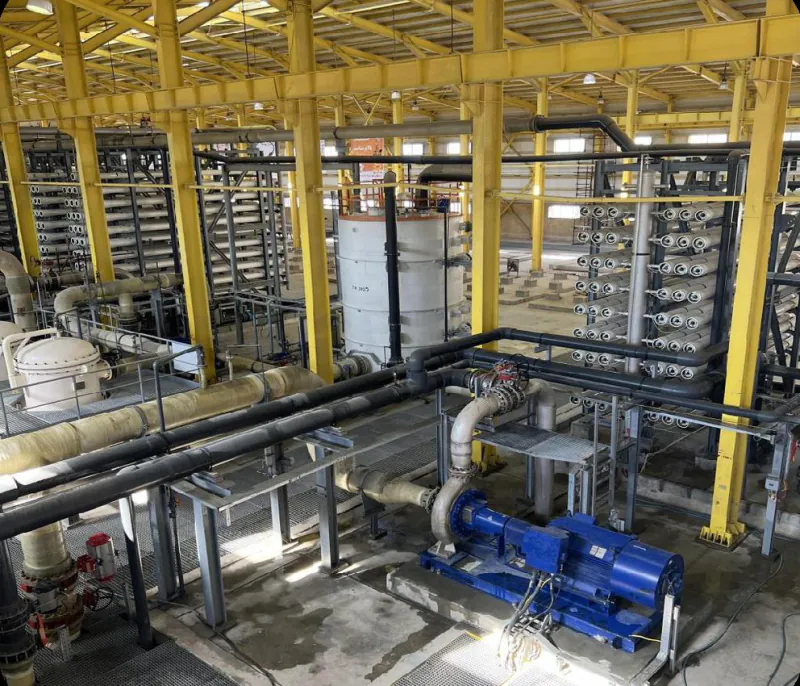
- Medium-pressure pumps and membranes designed for brackish water.
- Staged membrane arrays to raise the recovery ratio.
- A flushing and chemical cleaning system for the membranes.
Practical benefit
Lower operating pressure means smaller pumps and less energy per cubic meter; higher recovery means less reject water.
Evidence from the references
The two reverse osmosis passes
| Item | First pass (seawater) | Second pass |
|---|---|---|
| Differential pressure | 69 bar | 18.5 bar |
| Recovery ratio | 37% | 86% |
| Membrane model | SWC5-LD | CPA3 |
| Salt rejection | 99.8% | 99.7% |
| Pump power | 2,745 kW | 740 kW |
Data from the 100,000 m³/day desalination line reference. The second pass runs on low-salinity water with brackish-water class membranes.
Other solutions
Other areas of water solutions
Seawater desalination
Seawater reverse osmosis (SWRO) with pre-treatment, post-treatment and energy recovery.
DetailsDrinking water
Drinking water plants: coagulation, flocculation, sedimentation, sand filtration and disinfection.
DetailsIndustrial water
Demineralization and water polishing for utilities at industrial and petrochemical facilities.
DetailsWastewater
Biological wastewater treatment, including MBBR, with sludge treatment and disinfection.
DetailsCompact units
Standard water and wastewater units that install quickly and expand by adding identical modules.
DetailsRequest a study or proposal
Start with your project data.
Send us your project data. Our technical team reviews it and comes back with the right next step: a preliminary study, or a technical and commercial proposal.
Data that helps us prepare the proposal
- The water source and a recent analysis of it.
- The required capacity and its unit: m³/day or m³/h.
- The required product-water or effluent quality.
- The project site, available area and power source.
- The scope required: study, supply, or full execution.
- The expected project schedule.