
Technical solution
Drinking water treatment, pre-treatment and filtration
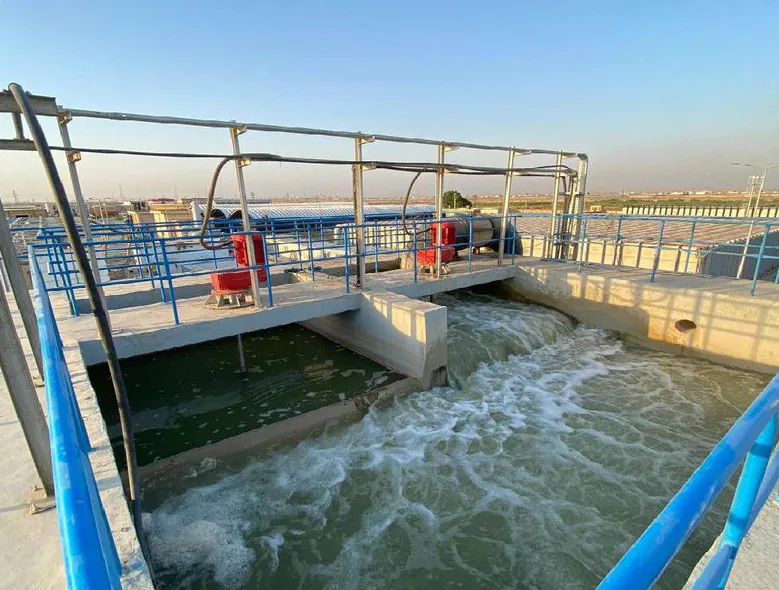
Conventional treatment removes turbidity and suspended solids from surface water in stages, then disinfects the water before it is pumped to the network. The same chain serves as pre-treatment ahead of desalination membranes.
Treatment chain
A conventional drinking water plant
- Raw waterIntake and pumps
- Rapid mixingCoagulant injection
- FlocculationFloc formation
- SedimentationFloc separation
- Sand filtrationRemoval of suspended solids
- Disinfection and storageThen pumping
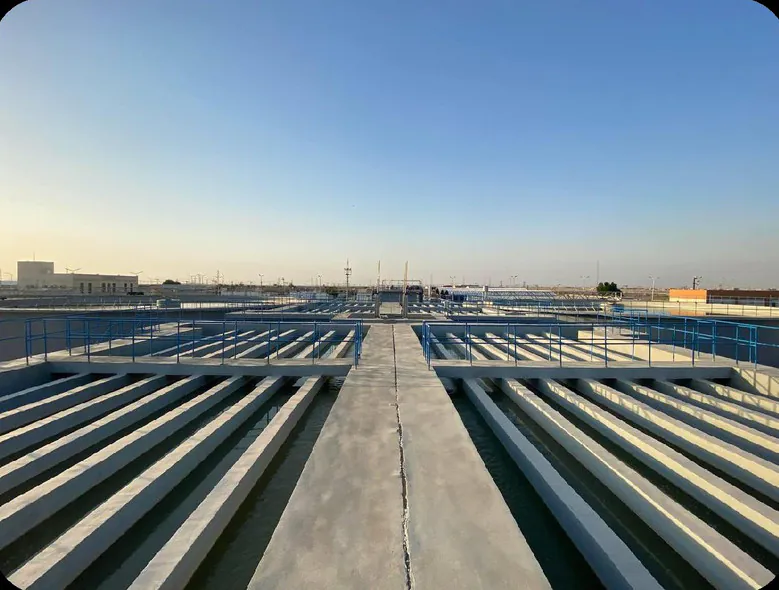
General illustration of a conventional drinking water plant.
Overview
Application
Drinking water plants for cities and districts, treatment of highly turbid river water, and pre-treatment for desalination plants.
Key technical elements
- Rapid mixing and flocculation: dosing of alum or ferric chloride and polyelectrolyte, followed by mechanical or hydraulic flocculation.
- Sedimentation: circular basins with scraper bridges, or pulsed clarifiers (Superpulsator).
- Dissolved air flotation (DAF): an alternative to sedimentation ahead of filtration for seawater.
- Filtration: gravity sand filters or dual-media filters (anthracite and sand) with water and air backwash.
- Disinfection: hypochlorite generated on site by electrochlorination.
- Sludge: storage and dewatering of alum sludge.
Practical benefit
A treatment chain that tolerates seasonal swings in source turbidity, and filtered water of stable quality that protects the units and networks downstream.
Related references
Al-Abbas water treatment plant
Conventional surface-water plant: 130,000 m³/day.
View reference Technical referenceUmm Qasr water plant with pulsed clarifier
1,000 m³/h
Basra project list Technical referencePre-treatment by flotation and filtration
200,000 m³/day desalination line.
View referenceOther solutions
Other areas of water solutions
Seawater desalination
Seawater reverse osmosis (SWRO) with pre-treatment, post-treatment and energy recovery.
DetailsBrackish water
Brackish water reverse osmosis (BWRO) at lower pressures and higher recovery than seawater.
DetailsIndustrial water
Demineralization and water polishing for utilities at industrial and petrochemical facilities.
DetailsWastewater
Biological wastewater treatment, including MBBR, with sludge treatment and disinfection.
DetailsCompact units
Standard water and wastewater units that install quickly and expand by adding identical modules.
DetailsRequest a study or proposal
Start with your project data.
Send us your project data. Our technical team reviews it and comes back with the right next step: a preliminary study, or a technical and commercial proposal.
Data that helps us prepare the proposal
- The water source and a recent analysis of it.
- The required capacity and its unit: m³/day or m³/h.
- The required product-water or effluent quality.
- The project site, available area and power source.
- The scope required: study, supply, or full execution.
- The expected project schedule.