Services
From studying the requirements to operation and maintenance
One workflow links the client’s data to the delivered solution. The company’s involvement at each stage is set by the contract: it may be limited to engineering and supply, or extend to execution and commissioning.
The three services
Studies, engineering and design
Water analysis, selection of the treatment chain, unit calculations and site layout.
DetailsSupply and systems integration
Supplying water-plant equipment and integrating it into one working system.
DetailsInstallation, commissioning and maintenance
Installing, testing and commissioning equipment, staff training and technical support.
DetailsService 1 of 3
Studies, engineering services and design
Good engineering starts with the water itself: analyzing the source, defining what is required, then selecting the treatment chain and sizing its units.
Application
New projects or expansions that need a technical study, basic and detailed design, or a review of an existing solution before supply and execution.
Scope of service
- Raw-water analysis and definition of the design basis and the required water quality.
- Selection of the treatment chain and preparation of the process flow diagram.
- Unit calculations: volumes, retention times, loading and filtration rates.
- Definition of equipment, quantities and the standby philosophy.
- General site layout and 3D modeling.
- Design of the sewer networks connected to the plants.
Practical benefit
Clear design documents that make offers easier to compare, define the equipment before purchase, and reduce changes during execution.
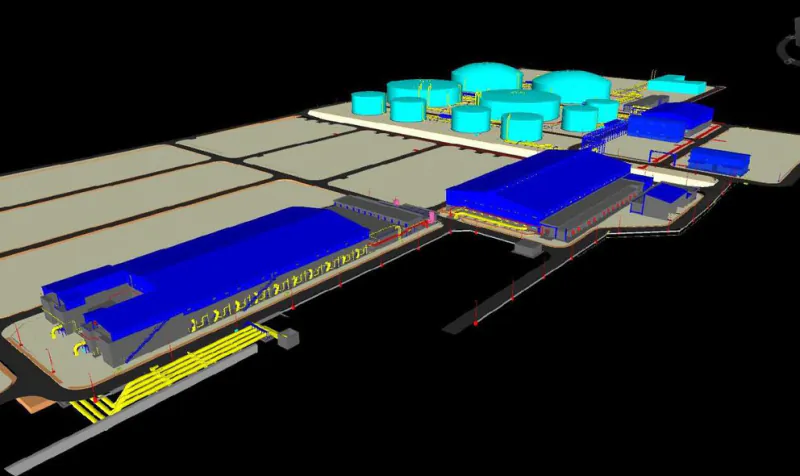
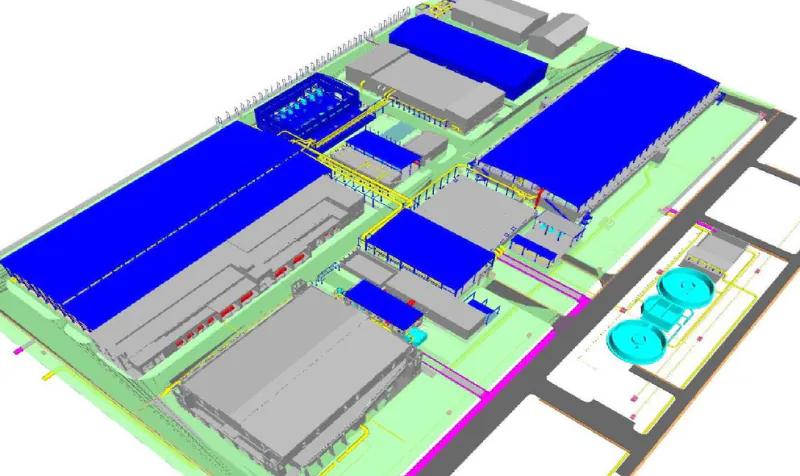
Design criteria from the references
| Criterion | Value | Reference |
|---|---|---|
| Filtration rate — dual-media filters | 5.95 m/h | 100,000 line |
| Flocculation time | 15.6 min | 100,000 line |
| DAF basin loading rate | 21.2 m/h | 200,000 line |
| Sedimentation basin surface loading | 34 m/day | Al-Abbas |
| Equalization basin retention time (average) | 1.34 hours | Al-Midaina |
| First-pass recovery (RO) | 37% | 100,000 line |
Service 2 of 3
Supply and integration of equipment and systems
We supply water-plant equipment from established manufacturers and bring it together into one system that works as an integrated unit.
Application
Equipment supply contracts for new plants, replacement and upgrading of existing units, or integrated equipment packages for a main contractor.
Scope of supply
- Pumps: feed, high-pressure, booster, backwash and product-water transfer.
- Reverse osmosis units: membranes, pressure vessels and support frames.
- Energy recovery: Pelton turbines and pressure exchangers.
- Filtration: dual-media and sand filters, cartridge filters.
- Biological treatment: MBBR basins, bioreactors and air blowers.
- Chemicals and disinfection: dosing systems, electrochlorination and UV.
- Storage and sludge: tanks, and sludge thickening and dewatering units.
- Electrical and control: motor control centre panels and operator screens.
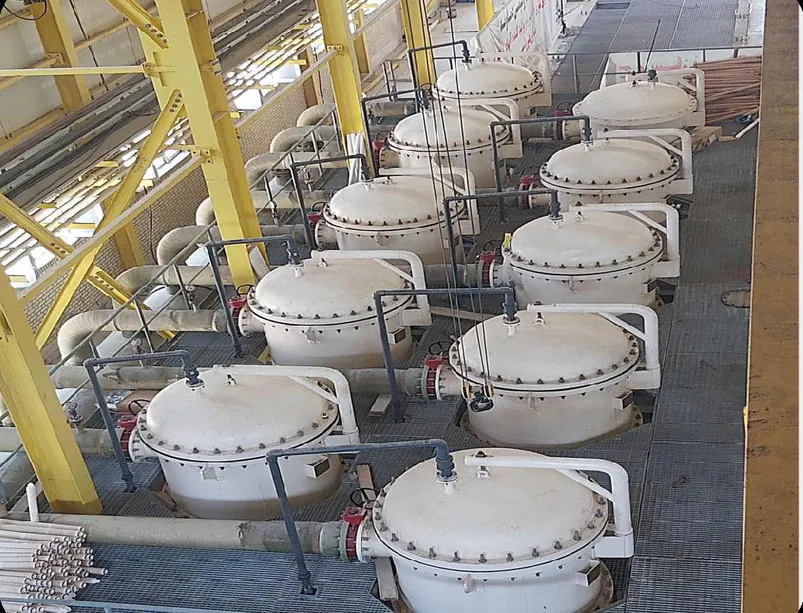
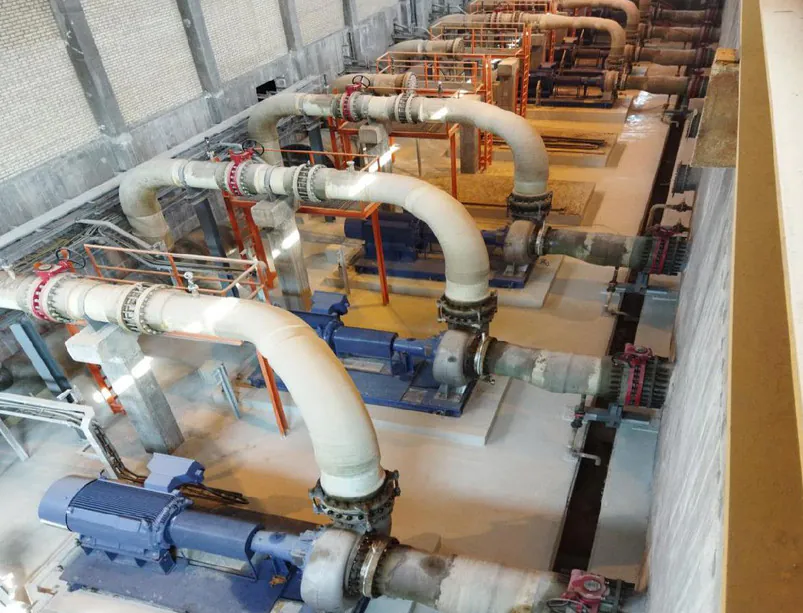
Integration: what turns equipment into a system
Matching specifications
Matching pump capacities, pressures and materials of construction to the water quality and operating conditions.
Interfaces
Coordinating the mechanical and electrical tie-in points and the control signals between units.
Standby
Defining duty and standby equipment for critical units, such as a (2+1) pump arrangement.
The desalination references used equipment from manufacturers such as Hydranautics (reverse osmosis membranes) and Energy Recovery (PX pressure exchangers). They are named here as technical documentation, not as a statement of agency or commercial representation.
Service 3 of 3
Installation, testing, commissioning and maintenance
Equipment delivers its full value once it runs on site as designed and is handed to staff who can operate it.
Application
New plants that need installation and commissioning, or existing plants that need rehabilitation or operating support.
Installation
- Installing mechanical equipment and piping.
- Electrical works and control panels.
- Connecting the units according to the drawings.
Testing
- Pre-commissioning equipment checks.
- Pressure and leak tests.
- Verification of instruments.
Commissioning
- Trial operation of the units.
- Setting dosing rates and process parameters.
- Monitoring product-water quality.
Maintenance and support
- Training the operating staff.
- Routine maintenance and chemical cleaning of membranes.
- Technical support and spare parts.
Practical benefit
One party responsible for carrying the design through to operation, and trained staff who take over the plant with its operation and maintenance documents.
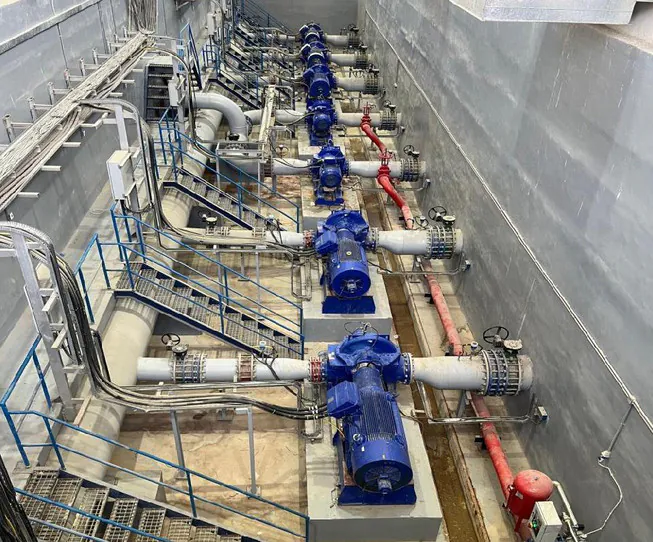
Rehabilitation of the Al-Sharash water complexes
Maintenance and rehabilitation of six water complexes in Al-Sharash: rehabilitation of sedimentation and collection tanks and filters, supply of alum and chlorine systems, and associated mechanical and civil works.
View projectProject cycle
From requirements to handover
One workflow links the client’s data to the delivered solution. The company’s involvement at each stage is set by the contract: it may be limited to engineering and supply, or extend to execution and commissioning.
- Defining requirementsThe water source and its analysis, the quantity required, the product-water or effluent quality, the site and the available area.OutputDesign basis
- Study and technology selectionComparing treatment alternatives and selecting the chain of units that suits the water quality and capacity.OutputProposed process flow diagram
- Engineering designUnit calculations, definition of equipment, quantities and standby, the general site layout and 3D models.OutputDesign documents and equipment lists
- SupplySupplying equipment and materials from the manufacturers and assembling the units.OutputEquipment that meets the specifications
- Installation and site worksInstalling mechanical and electrical equipment and connecting the units according to the drawings.OutputA fully installed plant
- Testing and commissioningChecking equipment, setting dosing rates and operating parameters, and verifying water quality.OutputPerformance test results
- Handover and supportHanding over documents, training the operating staff, and maintenance and technical support as agreed.OutputOperation and maintenance documents
What we need to start a study
A recent analysis of the raw water or wastewater, the required capacity and its unit (m³/day or m³/h), the required water quality, a site plan, and the available power source.
Sectors
Sectors and typical applications
We tie every solution to an actual need of the client: the water source, the water quality required, and the site and operating conditions.
| Sector | Typical applications | Related solutions |
|---|---|---|
| Government and municipal bodies | Drinking water plants, wastewater treatment plants and their networks, compact units for districts and sub-districts | Drinking water, wastewater, compact units |
| Oil, gas and petrochemicals | Cooling water, service and drinking water, fire-fighting water, demineralized water for utilities | Seawater desalination, demineralization |
| Industrial facilities | Feed and process water, water polishing, effluent treatment | Industrial water, biological treatment |
| Sites, compounds and camps | Containerized units producing drinking water, compact wastewater treatment units | Reverse osmosis, compact units |
| Consultants and contractors | Supply of equipment packages, and integration of treatment units within wider contracts | Engineering, supply and integration |
Request a study or proposal
Start with your project data.
Send us your project data. Our technical team reviews it and comes back with the right next step: a preliminary study, or a technical and commercial proposal.
Data that helps us prepare the proposal
- The water source and a recent analysis of it.
- The required capacity and its unit: m³/day or m³/h.
- The required product-water or effluent quality.
- The project site, available area and power source.
- The scope required: study, supply, or full execution.
- The expected project schedule.